A Group of Three Chinese Export Shagreen Traveling Cases
Country / Year: China, 19th century
Condition: Very Good
Measurements: H: ” / W: ” / D: “

$750.00
$750.00
A Group of Three Chinese Export Shagreen Traveling Cases
Country / Year: China, 19th century
Condition: Very Good
Measurements: H: ” / W: ” / D: “
Canton (Guangzhou), late 18th to early 19th century, circa 1780–1820
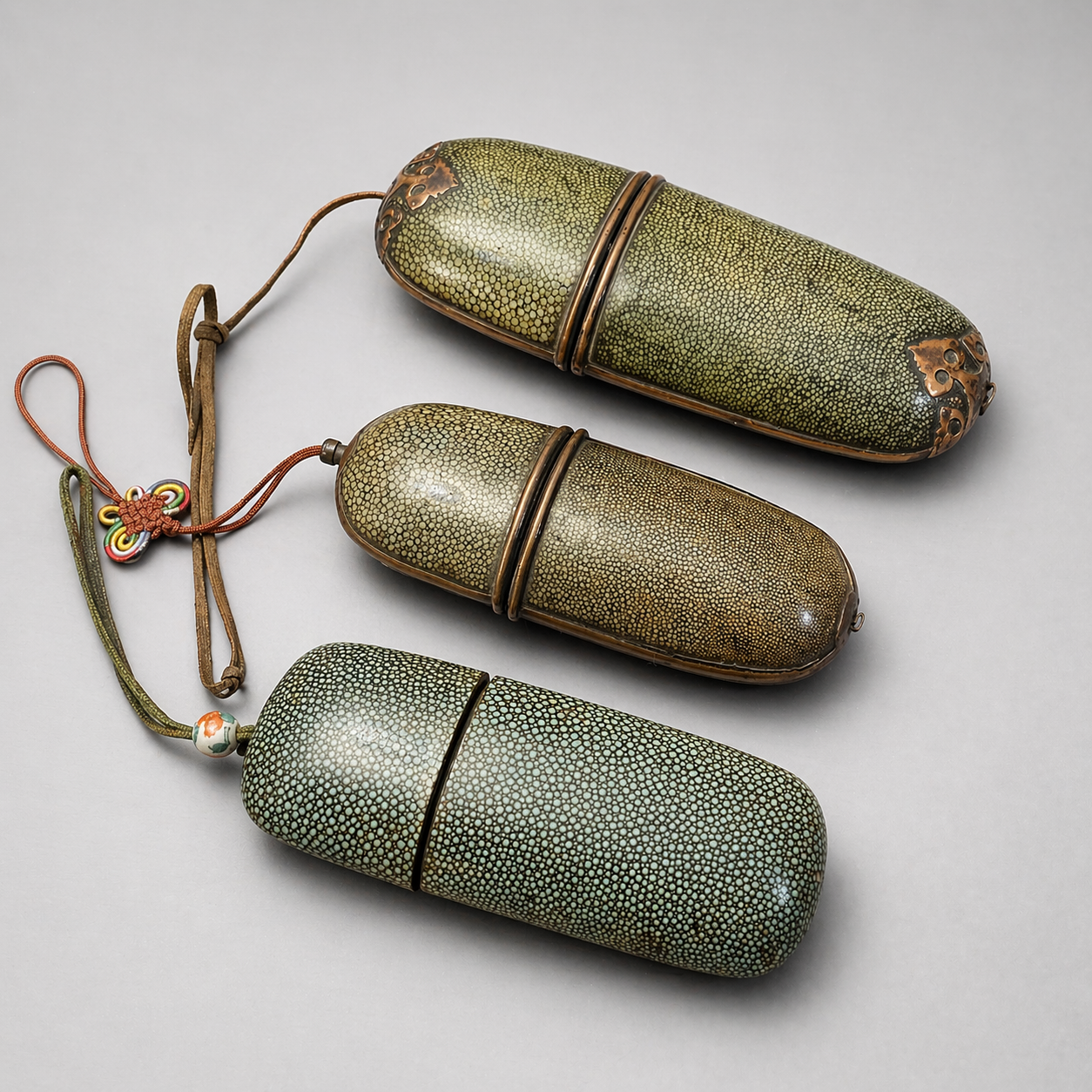
A rare and elegant group of three shagreen-covered traveling cases, combining refined craftsmanship with highly tactile natural materials. Each case is formed in a slender, elongated capsule shape, designed for portability and discreet personal use. The surfaces are clad in finely grained shagreen, displaying a dense pebble texture with subtle tonal variation. As a result, the cases possess both visual depth and a distinctive tactile appeal.
Each example is covered in carefully prepared shagreen, most likely stingray skin, prized for its durability and luxurious surface. The granular texture is remarkably even, indicating skilled preparation and finishing. In addition, the cases are fitted with patinated copper alloy mounts, including rim bands and terminal caps. One example retains applied corner plates, which add both protection and decorative contrast.
Moreover, the construction is precise and functional, with clean seams and well-aligned closures. The two-part form allows the cases to open smoothly while maintaining a secure fit when closed. The subtle variation in color, ranging from olive green to muted celadon tones, further enhances their visual richness.
These cases were designed for the safe transport of small personal items during travel. Most commonly, such forms were used for spectacles, small instruments, or writing tools. At the same time, their compact size made them suitable for medicine or scent-related contents. Therefore, they reflect the practical needs of mobility in the late 18th and early 19th centuries.
These objects were produced in Canton (Guangzhou), a major center for Chinese export art during the period. There, artisans created luxury goods specifically for European and international markets. Consequently, these cases embody a fusion of Eastern materials and Western functional design.
Furthermore, shagreen was highly fashionable in Europe during the 18th century, admired for its exotic origin and resilience. While European workshops also produced shagreen objects, these examples represent authentic Asian manufacture intended for export. Thus, they illustrate the global exchange of materials, techniques, and aesthetic preferences.
Overall, the group remains in very good condition, consistent with age and careful use. Minor surface wear and light patination are visible on the metal mounts. However, the shagreen coverings remain well-preserved, retaining their distinctive texture and coloration. In addition, the cases open and close smoothly, indicating sound structural integrity.
These shagreen cases offer a compelling combination of rarity, material richness, and historical significance. As a result, they appeal to collectors of Chinese export art, objects of vertu, and early global trade material. Moreover, their sculptural forms and refined surfaces make them ideal for display within a cabinet or curated interior.
Dimensions: Various
Origin: Canton (Guangzhou), China
Date: Circa 1780–1820